Guides
Window cleaning business insurance: coverage and risks
Window cleaning business insurance depends on access methods, payroll, limits, and claims history. Review common coverage and underwriting factors.
What to take away
- Window cleaning business insurance starts with general liability, the base layer commercial customers ask for. It usually excludes damage to the glass you are working on, and care, custody and control is the extension that answers for it.
- General liability for a solo operator doing ground-level residential work commonly runs from the low hundreds of dollars a year to about $1,500 at a $1 million limit.
- Workers compensation is rated on payroll and class code, so it is the line item that grows every time you hire. Check your class code against what your crews actually do.
- At $2 per $100 of payroll, a common janitorial rate, $150,000 of payroll carries a $3,000 base premium before experience modification.
- Premium is driven by access method, payroll, revenue mix and claims history. Limits, deductible and state move it too. Two companies with the same revenue can be quoted far apart and both quotes can be correct.
- Compare policy wordings, not price tags. Two quotes that differ on premium usually differ more on exclusions.
- Ask for certificates before you chase commercial work. Facility managers ask for them before they ask for a price.
This is general information, not insurance or legal advice. Policy wordings, state rules and workers compensation requirements differ, so take advice from a licensed broker and read the actual policy documents.
The coverages a window cleaning company usually considers
General liability. Third-party injury and property damage. Most commercial customers want a $1 million per occurrence limit and a $2 million aggregate, and this is the certificate a facility manager asks to see.
Four coverages window cleaners carry
General liability
- What it covers
- Third-party injury, damage
- Typical limit
- $1M / $2M aggregate
- Typical cost
- Low hundreds a year
- Who requires it
- Facility managers
Care, custody, control
- What it covers
- Glass you are working on
- Typical limit
- $25,000 or less
- Typical cost
- Endorsement or sublimit
- Who requires it
- Carrier option
Workers comp
- What it covers
- Employee injuries
- Typical limit
- State-set
- Typical cost
- $1.50-$5 per $100
- Who requires it
- Nearly every state
Commercial auto
- What it covers
- Business vehicle use
- Typical limit
- $1M liability
- Typical cost
- $1,200-$2,500 per van
- Who requires it
- State law
Carriers that quote small trades include Next Insurance, Hiscox, Thimble, biBERK and The Hartford. Brokers such as Insureon and Simply Business price several policies at once.
Care, custody and control. Damage to the property you are actually working on. Standard liability often treats this separately from other property damage, and glass is the item at issue. Where it is offered, it usually arrives as an endorsement or a sublimit of $25,000 or less, priced on the glass you typically handle.
Workers compensation. Required once you have employees in nearly every state, and sometimes structured through a state fund. Classification is set by your state authority, not by your broker's preference.
Janitorial work is often coded 9014, where rates commonly run about $1.50 to $5 per $100 of payroll. Exterior cleaning at height is usually coded higher. California, New York, Washington and Ohio run state funds that publish their own rates.
Commercial auto. Personal auto policies commonly exclude business use. Carrying water and equipment makes the vehicle unambiguously commercial. Expect roughly $1,200 to $2,500 a year per van at $1 million of liability, less for an older vehicle and a clean driving record.
Inland marine, or tools and equipment. Your own gear, in transit and on site. General liability does not cover it. Many policies carry a minimum premium near $250, with rates set per $100 of insured value.
Umbrella or excess liability. Additional limits above the primary policies, often demanded by larger commercial contracts. A $1 million umbrella for a small contractor commonly costs $500 to $1,500 a year, and $2 million to $5 million limits scale up from there.
Surety or janitorial bonds. Not insurance. A separate instrument some customers require. Pricing typically runs 1% to 3% of the bond amount, so a $10,000 janitorial bond costs about $100 to $300 a year.
What a premium actually looks like
No two quotes match, but the shape of a quote is predictable. A one-person operation doing ground-level residential work in a low-rate state might see a general liability premium in the low hundreds a year for a one million dollar limit.
Premium figures from the article
- $2 per $100workers comp rate example
- $180,000payroll example
- $3,600base premium result
- 0.80-1.25experience modifier range
Add a lift, a second van and two employees, and the same broker may quote several thousand. Workers compensation on payroll is now in the number, and so is commercial auto.
Treat those as illustrations, not rates. Your own figure comes from the arithmetic below, applied to your class code and your state's published rate.
Workers compensation is the line you can estimate before you call anyone. Take your annual payroll, divide it by one hundred, multiply by the rate per hundred dollars of payroll your state authority publishes for your class code.
At $2 per $100 of payroll, a $180,000 payroll gives a base premium of $3,600.
That product is the base premium before experience modification. A clean three-year claims history pushes the modifier below one; a single serious claim can push it above. Modifiers for small contractors often land between 0.80 and 1.25.
General liability is usually rated on revenue, sometimes with a minimum premium. Ask the broker what the minimum is and what revenue band it covers, because a small company can pay the minimum and still be quoted as if it were larger. Minimums commonly sit between $500 and $1,500 a year.
Monthly billing, offered by Next Insurance and Thimble among others, spreads the cost across twelve payments. Paying annually on the same policy usually costs less.
What actually moves the price
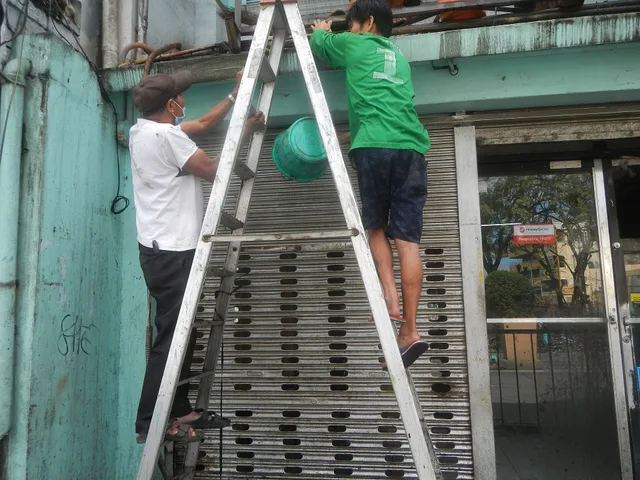
- Access methods and heights.Ground-level pole work, ladder work, lift work and rope access are progressively different risks. A quote given on the wrong description is worth very little when a claim arrives. Moving from ground work to lift work is often the biggest single jump, and some carriers decline rope access outright.
- Payroll and headcount.The main rating basis for workers compensation, and often a factor in liability. At a $2 rate per $100 of payroll, $100,000 of payroll adds about $2,000.
- Revenue and service mix.Post-construction and restoration work read differently from routine maintenance. Post-construction cleaning, with grit and paint on the glass, is often rated higher.
- Claims history.Yours, in detail, over several years. Even a closed claim with no payout can affect the modifier.
- Limits and deductible.The levers you actually control at the point of purchase. Moving the deductible from $500 to $2,500 commonly lowers the premium.
- State and class code.Both are set by where you work and what you are coded as. A wrong code is worth checking. The gap between a $1.50 rate and a $6 rate per $100 of payroll is $4,500 a year on $100,000 of payroll. The Oregon Department of Consumer and Business Services publishes an annual ranking of workers compensation rates by state, and it is free to look up.
Because these are the drivers, two window cleaning companies of identical revenue can receive very different quotes, and neither is being treated unfairly.
What moves the price most
- Payroll $100,000 at $2 rate$2,000
- Rate gap $1.50 vs $6$4,500
- Deductible $500 to $2,500lowers premium
Reading the wording before the price
Six questions to ask the broker in writing. Save the answers with the policy.
- Which services, access methods, and heights are included in the application and policy?
- What liability limits, deductibles, and exclusions apply to the work?
- Does this policy include the care, custody and control (CCC) endorsement, what is its form number, and what sublimit applies?
- Which workers compensation class code will be used for each type of work, and how will payroll be audited?
- What training, equipment inspections, or recordkeeping conditions must we meet?
- What certificate limits and additional-insured terms can the policy provide for the customers we target?
Six questions for the broker
- How is damage to the work property treated?
- What heights and access methods are covered?
- Is there a floors-above exclusion?
- Are subcontractors covered and what must they hold?
- What conditions does the policy impose?
- What is the incident notification requirement?
The fifth question is where small companies lose claims. A condition requiring documented training or equipment inspection is a promise you made, and it is checked after the loss rather than before.
The cleaning industry hazard material from the Occupational Safety and Health Administration sets out the chemical and slip exposures such a condition usually addresses. If records exist only in memory, the condition is not met.
What the insurer is really assessing
An underwriter is trying to work out whether your company plans its work or improvises it.
Fall protection is the clearest signal. The fall protection guidance from the Occupational Safety and Health Administration treats protection as arranged before work starts. Rope access technique and anchor selection are not something this article covers; those sit with CSA Z91 and Z271 and a certified trainer.
For suspended work in the United States, ANSI/IWCA I-14.1 is the window cleaning safety standard many contractors work to. The International Window Cleaning Association runs safety training and an annual convention, and its members are one place to ask which class code carriers use in your state.
A company that can show a written access policy, an equipment inspection log, and signed training records describes a different risk from one that cannot.
That documentation is also what a commercial customer asks for during vendor onboarding, so it does double duty. The ADA Guide for Small Businesses is worth having read for the same reason: obstructing an accessible entrance with equipment is both a liability exposure and a complaint waiting to happen.
Buying it sensibly
Describe the work accurately, including the worst job you take. A policy priced on routine ground-level work will not respond well to a lift job you did not mention.
Buying insurance sensibly
- Describe the work, including the worst job
- Compare wordings, not premiums
- Check customer certificate requirements first
- Get three quotes on one written description
- Review annually and at every change
Compare wordings, not premiums. Two quotes that differ on price usually differ on what they exclude.
Check the certificate requirements of the customers you want before you buy. Commercial vendor terms often specify limits and additional insured status, and buying to a limit below that means buying twice. Most ask for $1 million per occurrence and $2 million aggregate; larger contracts sometimes ask for more and want a $1 million umbrella behind it.
Get three quotes on one description. Give every broker the same written scope, payroll figure and limits, or the quotes cannot be compared. Direct carriers such as Next Insurance and Hiscox, and brokers such as Insureon, are different channels on the same policy.
Review annually and at every change. New access method, new vehicle, first employee, new service line. Each of these can invalidate an assumption the quote was built on.
Where insurance sits in the wider picture
Insurance is one layer of a stack that also includes registration, local licensing, tax and employer obligations. Read it alongside the licensing and compliance guide rather than as a separate task, and check the specific permissions you need against the article on what licenses a window cleaning business needs.
Two decisions feed straight into the premium. What you buy and how you reach the glass, settled in the equipment and setup decisions.
And whether you have employees at all, which starts when you begin hiring reliable window cleaning staff and brings workers compensation with it.
Common questions
How much does window cleaning insurance cost?
There is no single number. A solo operator doing ground-level residential work may pay a few hundred dollars a year for general liability, while a crew running lifts and carrying payroll can pay several thousand once workers compensation is included.
Workers compensation moves that figure more than anything else. The same $100,000 of payroll costs about $1,500 at a $1.50 rate per $100 and about $6,000 at a $6 rate.
Get three quotes from brokers who write this trade, give all three the same accurate description, and compare the wordings side by side.
Do I need insurance before my first job?
Before you touch anyone else's property, yes. The first broken pane is the wrong moment to find out you were uncovered, and many customers will not let you start without a certificate.
Does my personal auto policy cover the van?
Almost certainly not for business use. Ask the question directly and get the answer in writing, because this is one of the most common uninsured exposures in mobile trades.
Are sole operators exempt from workers compensation?
It varies by state, and the exemption is often narrower than people assume. Ask your state's workers compensation authority about your own arrangement rather than relying on what another operator told you.