Guides
Window cleaning staffing: from hire to trained
Window cleaning hiring and training: design the roles first, hire for reliability, run a lawful process, and train as a competency record with sign-offs.
What to take away
- Hire for reliability and trainability. Technique can be taught in weeks; turning up on time at a stranger's house cannot.
- Design the roles before you advertise. A company that hires "a window cleaner" gets a different person every time.
- Training is a competency record, not an afternoon. Nobody works unsupervised on a method until they are signed off on it.
- Turnover is the largest hidden cost in this trade. Every departure takes route knowledge, customer relationships and training investment with it.
- No wage, rate or ratio is stated here. Where pay is discussed, this page names the source to look it up from.
Employment law, classification and safety obligations depend on your jurisdiction and change over time. Take qualified employment and safety advice before hiring or before putting anyone on a ladder.
Design the roles first
Three roles cover most companies of one to three vans.
Three core window cleaning roles
Technician
- Cleans to standard
- Yes
- Follows daily routine
- Yes
- Makes day decisions
- No
- Measures and quotes
- No
- Sets price of work
- No
Crew lead
- Cleans to standard
- Yes
- Follows daily routine
- Yes
- Makes day decisions
- Yes
- Measures and quotes
- No
- Sets price of work
- No
Surveyor / estimator
- Cleans to standard
- No
- Follows daily routine
- No
- Makes day decisions
- No
- Measures and quotes
- Yes
- Sets price of work
- Yes
Technician. Cleans to a written standard, follows the daily routine, reports what is found. The role most companies actually need, and the one most often advertised vaguely.
Crew lead. Everything above, plus the day's decisions: sequence, access problems, whether a job is out of scope, whether conditions allow work at height. Judgment, and the ability to talk to a customer without escalating.
Surveyor or estimator. Measures, scopes and quotes. In a small company this is the owner, and it is usually the last thing an owner should hand over, because it sets the price of everything else.
Write one page per role: what the person does, what they decide, what they must never decide, and what they are signed off on. That page is the job advertisement, the training plan and the review document all at once.
What actually predicts a good hire
Experience in the trade is useful and it is not the strongest signal. Four things predict better.
Four predictors of a good hire
- Attendance historyreliable elsewhere, reliable here
- Comfort at height, honestly stated
- Care with other people's property
- Willingness to be corrected
- Attendance history.Someone who has been reliable elsewhere will be reliable here.
- Comfort at height, honestly stated.A person who says clearly that they do not want to work from a ladder is more useful than one who agrees and freezes.
- Care with other people's property.Ask about a time they damaged something and what they did. The answer tells you everything.
- Willingness to be corrected.This trade is full of small technique adjustments. Someone who cannot take one will plateau.
Technique is the thing you can teach. Everything above is the thing you cannot.
The hiring process, step by step
Reliability is mostly decided before anyone starts. Run the same process every time.
The hiring process
- Write the role on one page.What the person does, what they decide, what they must never decide, and the methods they will be trained and signed off on.
- Advertise the job as it is.Hours, days, pay basis, the physical reality, and whether the work involves heights. An advertisement that hides the hard parts recruits someone who leaves soon after starting.
- Screen on attendance, not on enthusiasm.Ask about the last two jobs: hours, punctuality, and why each ended. Vague answers here are the strongest early warning sign.
- Interview everyone with the same questions.Written down in advance, asked in the same order, scored against the role page. That is fairer and more accurate.
- Run a paid working trial.Half a day on real glass, with somebody watching. Pay for it.
- Check references for attendance and conduct, not for technique. Ask a former employer whether they would rehire.
- Document the start.Written terms, pay basis, hours, and the training modules the person is not yet signed off on.
Skipping the working trial is the most common shortcut and the most expensive one.
The four questions worth asking
Ask all four, of everyone, and write the answers down.
"Tell me about a time you damaged something at work. What happened next?" Listen for whether they reported it. Everybody breaks something eventually. What matters is whether you hear it from them or from the customer.
"How do you feel about working from a ladder?" An honest no is useful information and costs nothing to accommodate. Someone who agrees reluctantly is a hazard to themselves and to the schedule.
"What would you do if a customer asked you to clean something that was not on the job sheet?" You are testing whether they will improvise. The right answer is to report it and get it priced.
"When were you last told you were doing something wrong, and what did you do?" This trade is a sequence of small corrections. A person who cannot accept one will stop improving early.
Running a fair and lawful hiring process
The obligations start before the first advertisement, not at the offer.
Lawful hiring process steps
- Write job requirements before advertising
- Ask every candidate the same questions
- Check federal and state pay and hour rules
- Classify workers correctly before first start
The small business guidance from the U.S. Equal Employment Opportunity Commission sets out what federal anti-discrimination rules require from employers, including how job requirements, interviews and decisions should be handled. Two practical consequences: describe the job by what it requires rather than by who you imagine doing it, and ask every candidate the same questions.
On pay, hours and records, the wage and hour compliance assistance for small businesses from the U.S. Department of Labor covers the federal expectations. State law layers on top and is often stricter, so check both before writing an offer.
The classification question deserves its own paragraph. Treating a worker as a contractor because both sides prefer it does not make it correct, and the consequences of getting it wrong, back wages, back taxes and penalties, land on the employer. Take advice once, before the first person starts.
Setting pay you can recruit against
A pay rate that nobody accepts is a plan to be short-handed in spring, and a rate you cannot support is a plan to lose money on every job.
Start from what the roles you need actually pay in your own metro area, using the Occupational Employment and Wage Statistics tables from the U.S. Bureau of Labor Statistics. Treat it as one input rather than a rate card, add the employer burden on top, and only then check it against your own price.
If the two do not meet, the price is usually the thing that is wrong.
Training as a competency record
Training in this trade is not a day. It is a list of methods, each with a sign-off.
Eight training modules with sign-off
- Inductioncompany, standard, safety
- Ground-level techniquesqueegee, edges, frames
- Chemicals and hazard awareness
- Ladders and access methods
- Scrapers and blades
- Pure-water systems where used
- Customer contact and scope
- Reporting and records
A workable structure:
- Induction.The company, the standard, the daily routine, safety basics, and what to do when something goes wrong.
- Ground-level technique.Squeegee work, edges, frames, detailing. Practiced on the company's own glass before a customer's.
- Chemicals and hazard awareness.What is carried, what the safety data sheets say, what protective equipment goes with each. The cleaning industry hazard material from the Occupational Safety and Health Administration sets out the exposures this trade carries and is the basis for this module.
- Ladders and access.Only the methods your company performs, taught by someone competent, with the limits stated.
- Scrapers and blades.Taught separately, because this single tool causes most of the permanent glass damage in the trade.
- Pure-water systems, where used: purity, brush handling, rinse discipline, freezing precautions.
- Customer contact.How to greet, how to report, how to say no to work that is out of scope.
- Reporting and records.Photographs, times, notes, and what a variation is.
Each module ends with an observed task and a signed record. Nobody works unsupervised on a method until that record exists, and the record is also what an insurer and a commercial customer will ask to see.
Keeping people
Turnover costs more than it appears, because a departure takes route knowledge and customer familiarity as well as the training investment.
Four things hold people in small trade companies. Predictable hours, so life can be planned. Equipment that works, since nothing corrodes morale faster than fighting a failing pump. A visible path from technician to crew lead with a stated standard for the step. And being told when the work is good, which is free and rarely done.
Exit conversations are worth having and worth writing down. The reasons people leave repeat, and they are usually fixable.
Supervision after sign-off
Signing somebody off is the start of supervision, not the end of it. For the first weeks after a module is signed, the work on that method should be sampled: a visit to a finished job, a look at the photographs, a question about a decision they made on site.
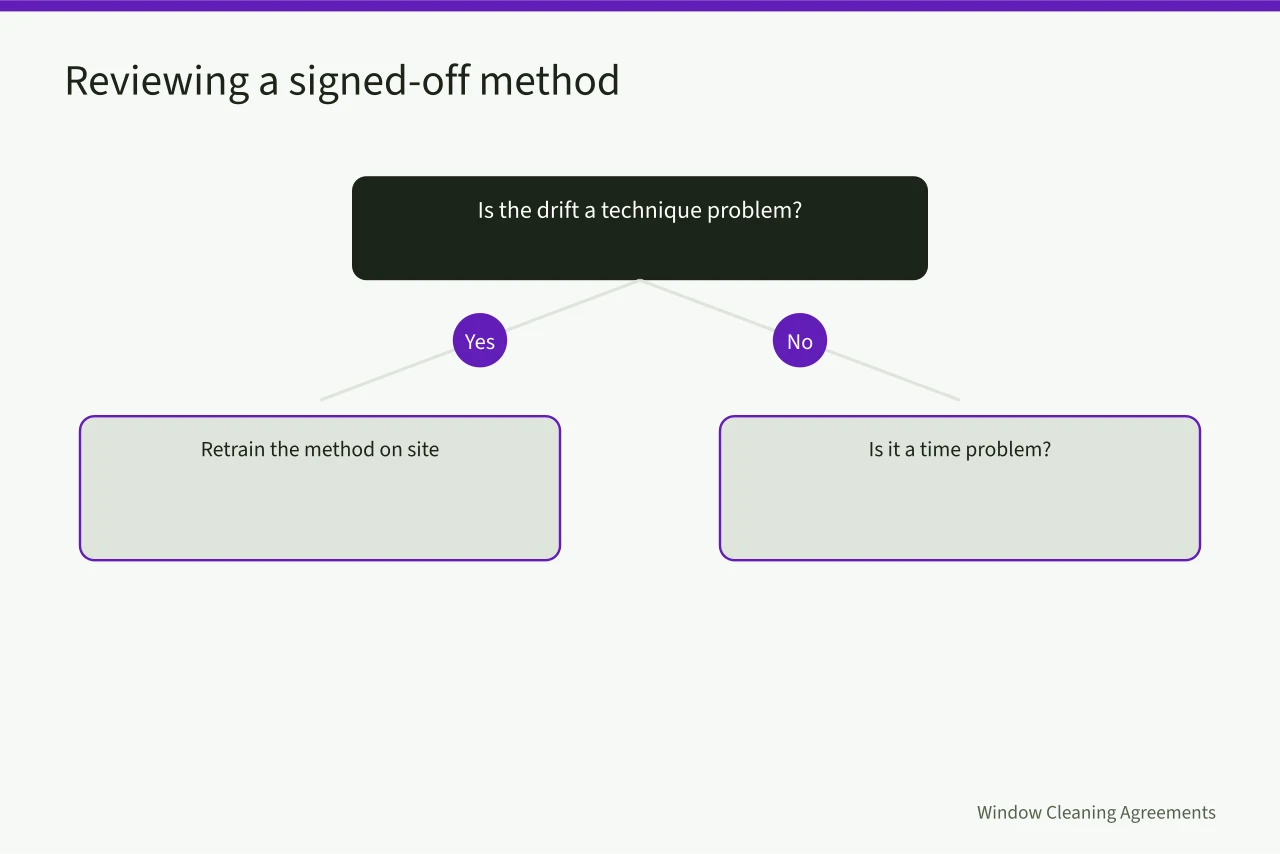
The purpose is not surveillance. It is to catch the drift that happens when a taught method meets a real building with a hedge in the way, and to catch it while it is still a conversation rather than a habit. Drift is normal and it is cheap to correct early.
Two habits make this work. Say what was good before saying what was wrong, because a review that is only corrections stops producing honest answers. And separate a technique problem from a time problem before you address either, since a crew that is running late will drop the final walk-around no matter how well it was trained.
What the crew has to be given to succeed
Three things sit outside training and decide whether it holds.
Equipment that matches the method taught, which is settled in the equipment and setup decisions. A day with enough room to work properly, which comes from the operations and workflow routine rather than from effort. And a scope the crew can check against, taken from the same service menu and package wording the customer was quoted from.
Two constraints frame all of it. The employment obligations that begin at the first hire sit inside wider licensing and compliance requirements. The wage you can afford follows from pricing and profit decisions, not an independent choice.
Whether there are people to hire at all is a feature of the area. That is part of reading your local market properly before you plan a second crew.
Common questions
Should I hire experienced window cleaners or train from scratch?
Both work. Experienced hires arrive faster and bring habits you may not want; trained hires take longer and learn your standard first. What matters more is that your standard exists in writing, because without it an experienced hire simply keeps their old one.
When is the right time to make the first hire?
When the route is dense enough that a second person has full days on the same weekdays, and when the daily routine is written down. Hiring before either of those is how a company acquires its worst habits.
How do I handle someone who is fast but leaves streaks?
As a method problem with a deadline. Retrain, observe, and set a date for the review. Speed without the standard is not productivity; it is rework moved to next week.
Do I need a formal probation period?
Some structured review early on is sensible, and its legal form depends on your jurisdiction. Take advice on how to do it properly rather than copying a template from another state.