
Guides
How to price window cleaning services: a formula framework
How to price window cleaning services with a formula framework for measuring productive time, labor, overhead, and converting costs into job quotes.
What to take away
- Derive your rate, do not pick it. The arithmetic below takes about an hour and replaces every guess you would otherwise make for a year.
- Price the working day, then divide it into jobs. Pricing a single job first is how travel and setup vanish from the number.
- Your target is a rate that pays a wage, covers overhead and leaves something over. Write down which of the three a low quote is sacrificing.
- Rework and unpaid driving are the two costs that never appear on an invoice and always appear in the bank account.
- No rate or margin is stated on this page. Every input comes from your own timings and your own quotes.
This is general business guidance rather than tax or accounting advice. Employment costs and tax treatment vary by jurisdiction, so take qualified advice before relying on any figure you build.
Step one: measure the day, not the job
Take a normal working week and record, honestly:
Hours in a paid day
- Hpaid hours per crew member
- Phours actually cleaning on site
- Tdriving, parking, loading, setup
- Aquotes, calls, invoicing, admin
Step one: measure the day
- H
- = paid hours in the day, per crew member
- P
- = hours actually on site cleaning
- T
- = hours driving, parking, loading and setting up
- A
- = hours on quotes, calls, invoicing and admin
Then productive share = P divided by H. Almost nobody likes their first answer. That is the point: a rate built as though every paid hour were productive will underprice every job you ever quote.
Step two: build the cost of an hour on site
Assemble these from your own records and quotes:
From wage to break-even rate
- W plus B divided by productive share
- Add V vehicle cost per hour
- Add C consumables per hour
- Add F divided by N overhead
- Result: break-even rate, the floor
- W= hourly wage for the role doing the work, or your own opportunity cost if you are the crew
- B= payroll burden on top of W: employer taxes, workers compensation, paid time
- V= vehicle cost per working hour: payment, fuel, maintenance, insurance, divided by working hours
- C= consumables per working hour, from a month of restock receipts
- F= fixed overhead per month: insurance, licensing, software, phone, storage, accounting
- N= productive hours the company sells per month
Then:
Step two: build the cost
- Direct cost per productive hour
- = ((W plus B) divided by productive share) plus V plus C
- Overhead per productive hour
- = F divided by N
- Break-even rate
- = direct cost per productive hour plus overhead per productive hour
That break-even rate is the floor. Anything below it is a job you are paying to do.
For W, start from what the roles actually pay near you rather than from what you hope to pay. The Occupational Employment and Wage Statistics tables from the U.S. Bureau of Labor Statistics publish estimates by occupation and metro area, and they are one input to a pay decision rather than a rate card.
Step three: add the margin deliberately
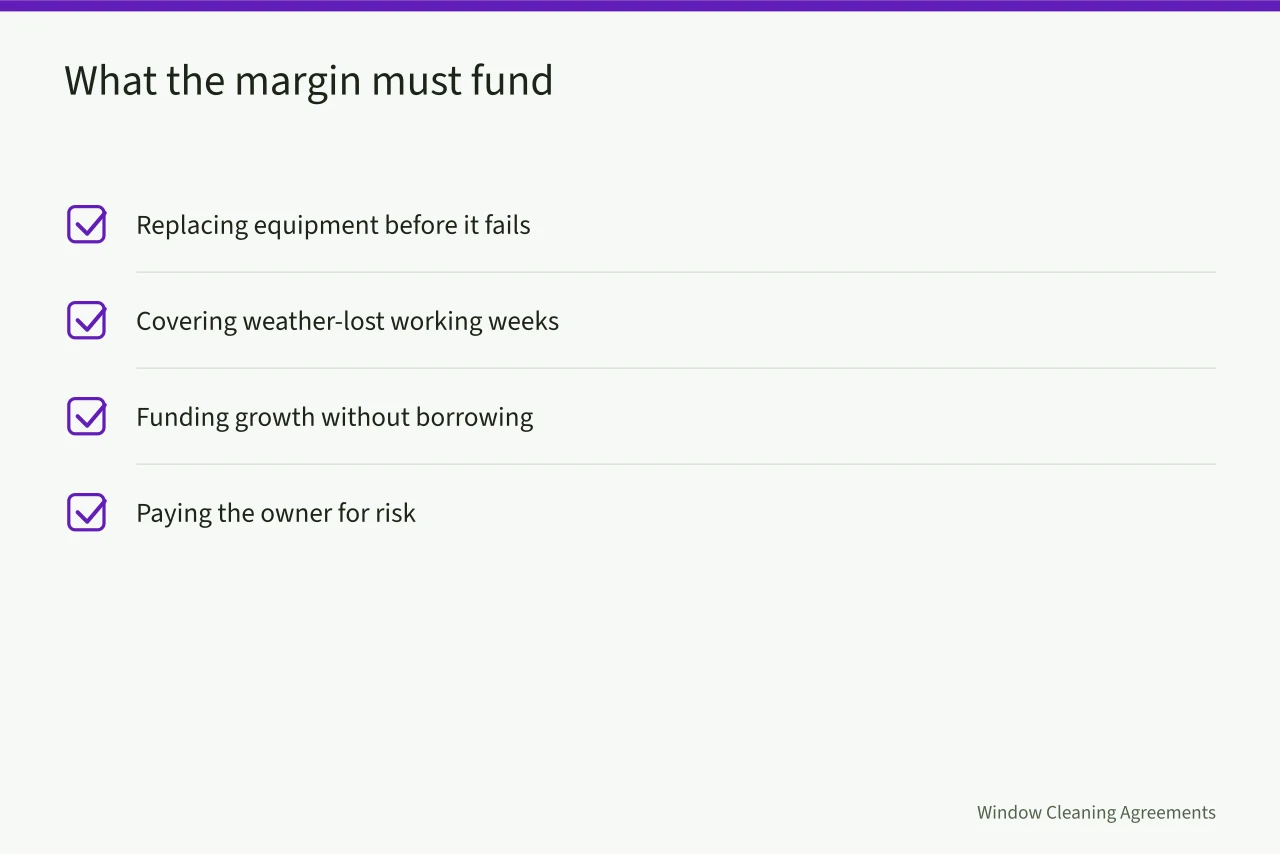
Margin is not a leftover. Decide what it is for and say so:
Step three: add the margin
- Replacing equipment before it fails
- Covering the weeks when weather removes working days
- Funding growth without borrowing
- Paying you, the owner, for risk rather than for labor
Set the target as a percentage above the break-even rate, write down the reason, and then apply it consistently. A margin chosen per quote is not a margin, it is a mood.
Step four: convert to the unit the customer buys
Customers do not buy hours. They buy a clean building.
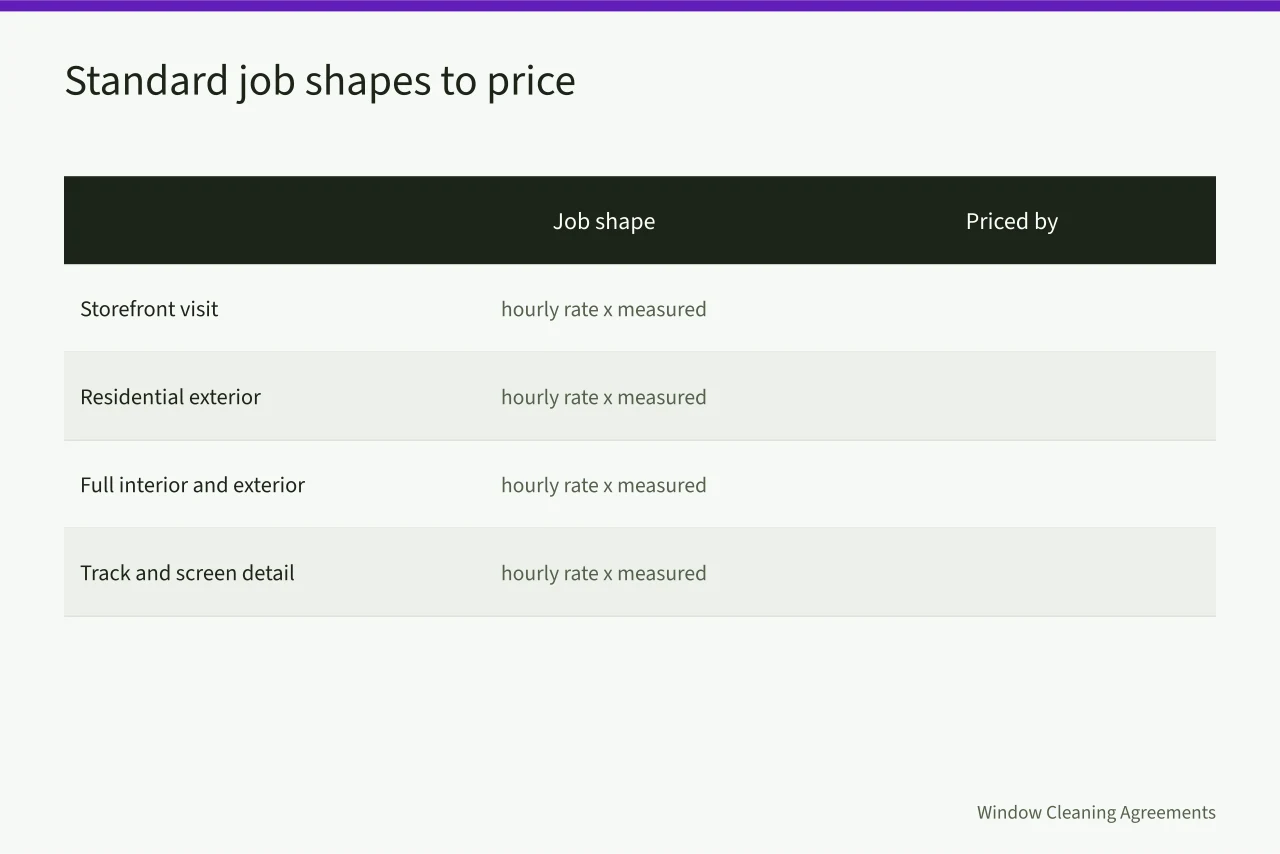
Take your target hourly rate and your measured time for a job type. Multiply. That is your price for that job type. Do it for each of your standard shapes: a storefront visit, a residential exterior, a full interior and exterior, a track and screen detail.
Then sanity-check against condition and access. A first clean on neglected glass, restricted building access, or a ladder job for a few panes takes longer than the standard shape.
For each job shape, record the standard time and the actual time for a comparable job with the added condition or access issue. Divide the actual time by the standard time; that observed ratio is the multiplier. Keep condition and access separate when the work allows, so you can see which added time the quote reflects.
Step five: test the price against a full day
Lay out a realistic day of the jobs you just priced, in the geography you actually serve, with the driving included. Add the revenue. Compare it to the cost of that day.
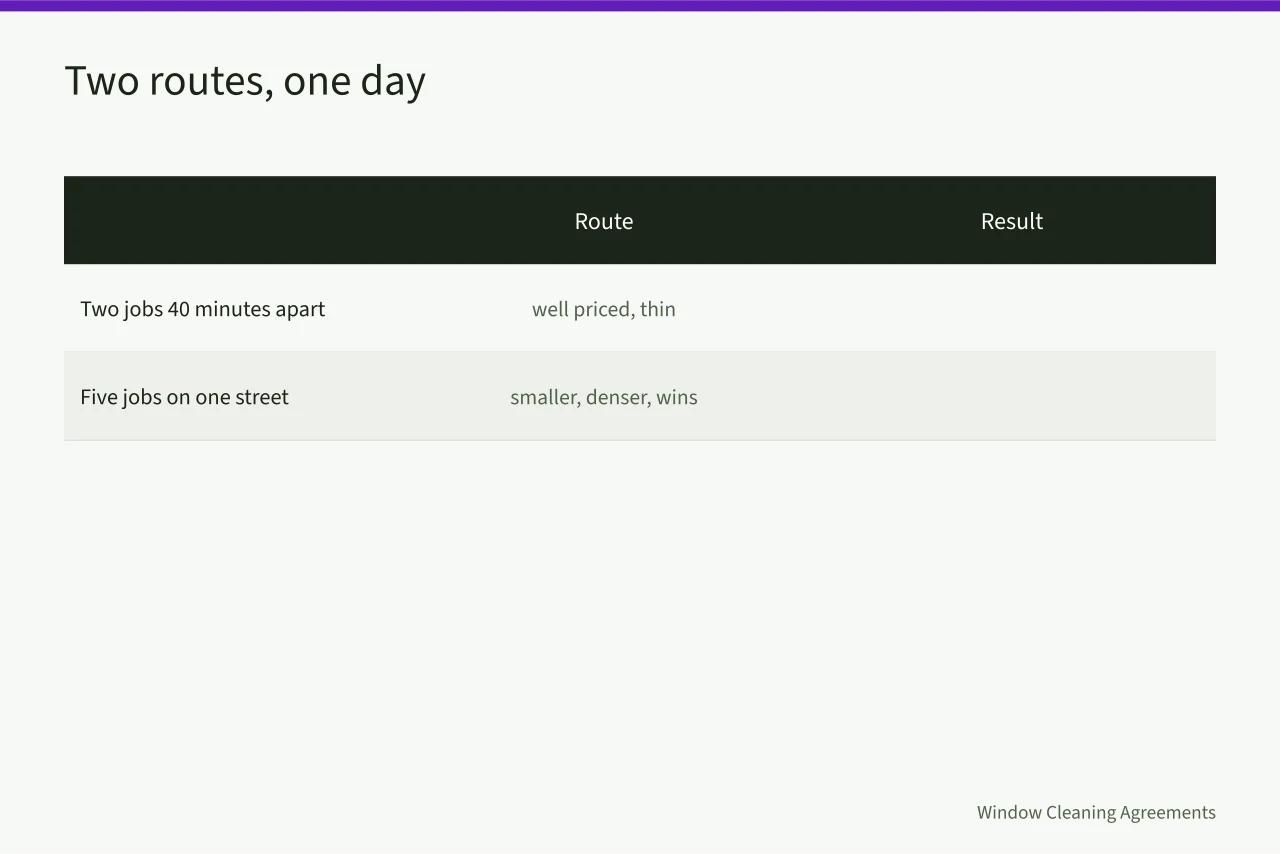
This is where thin routes reveal themselves. Two well-priced jobs forty minutes apart can lose to five smaller jobs on one street, and no per-job calculation will ever tell you that.
The two costs nobody quotes
Unpaid drive time. It is in T above, and it is the reason density beats ticket size. The fix is a stated service radius and batching outlying work onto one day.
Rework. A return visit costs a full visit and earns nothing, so it removes the margin from the original job and often from the next one too. Rework is usually caused by rushing a price that was too low, which makes it the most self-inflicted cost in the trade.
Keeping the records the method needs
None of this survives without per-job records: time on site, travel, materials, and revenue collected. The Internal Revenue Service recordkeeping guidance sets out the standard a system has to meet to show income and expense clearly, and that is the same standard that lets you rebuild this calculation next year instead of starting over.
Saying the price out loud
Two rules keep pricing conversations short.
Give a scope with every number. A price without a scope is an argument with a delay built in.
And be careful what you attach to the number. Guarantees, comparisons and outcome promises are advertising claims that have to be supportable, which the Federal Trade Commission advertising guidance for small business sets out plainly. "Streak-free, guaranteed" with no stated condition is a claim you will be held to on a building with sprinkler spotting.
Where the inputs come from
Two inputs to this method are decided elsewhere. V and C depend on what you run and what it consumes, which is settled in the equipment and setup decisions. W and B depend on how you staff, which is the work of structured hiring and training rather than a number you can choose.
The ranking that tells you which jobs to sell more of is in the most profitable window cleaning services. For billing basis, agreements, and price increases, the wider guide is the one to read. It is the window cleaning pricing and profit guide.
If you have not started and have no timings, the sequence for getting them is in the guide to starting a window cleaning business.
Common questions
What if my derived price is above the local market?
Then you have learned something specific: either your productive share is low, your route is thin, or local prices are being set by companies not paying a full wage. Check your own inputs first, then decide whether to compete on density instead of on price.
Can I use a simple rate per pane instead?
Yes, once you have derived it from the arithmetic above. The rate per pane is an output of this method, not an alternative to it.
How do I price a first clean on neglected glass?
Time a comparable job before quoting, or quote it as a separate first visit with its own scope. Pricing a heavy first clean at maintenance rates is the most common way a good agreement starts badly.
Should I ever quote below break-even?
Only knowingly, for a stated reason, with an end date. Entering a building you want, or filling a gap in an existing route, can justify it. Doing it because a customer pushed back cannot.